
ART D'ECCO
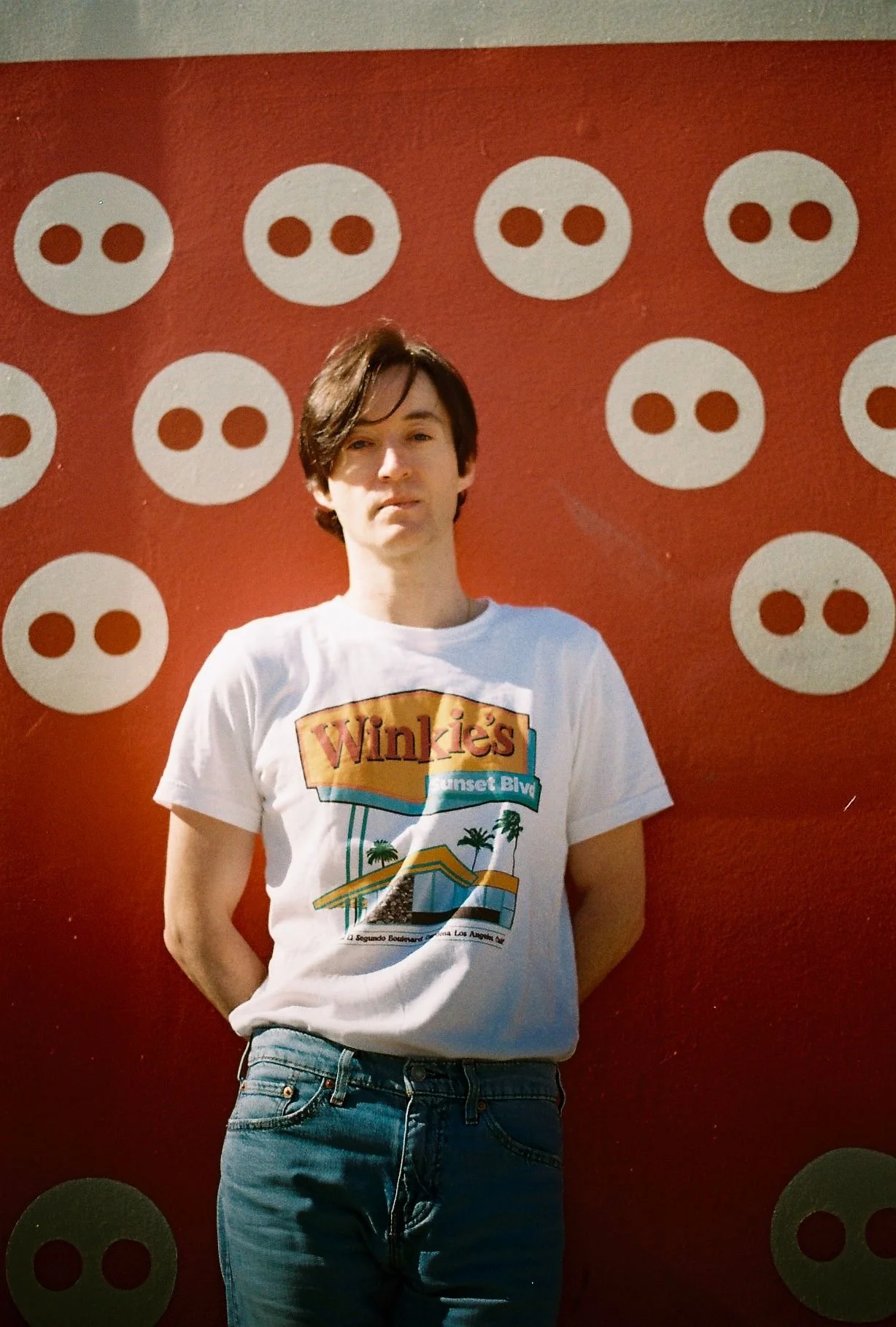
Art d’Ecco wanted to be someone entirely different. In the ten years since he first adopted his musical nom de guerre, Art has already been many versions of himself–an elusive art-pop architect, a canny glam rocker, most recently a louche poet ambling the streets of New York deep into the night on last year’s Serene Demon. But this time, Art questioned the whole endeavor of making art in the face of an impending doom promised by a seemingly never-ending onslaught of contemporary societal ills. He sought to burn it all down. The result is his fifth album, Scheele’s Green, a fiery reckoning with the world around us and the crucible in which Art d’Ecco dies to be reborn again. “I want people to hear this album and say, ‘That’s Art d’Ecco??’” he proclaims.
For Scheele’s Green, the malaise and disorientation he felt in an era plagued by technocratic billionaires rising up like Bond villains sent him down a historical rabbit hole, tracing generations of self-destructive human behavior. The album is named for an actual colour, first synthesized by Carl Wilhelm Scheele in 1775. With the shade previously hard to attain, Scheele’s green quickly became a status symbol for the wealthy, who covered their homes and bodies in it. Just as quickly, they became afflicted with strange ailments thanks to the arsenic compounds needed for the colour. Scheele’s green soon became identified as a dangerous luxury the affluent were nevertheless reluctant to quit. “It created this literally toxic society,” Art describes. “This addiction, this allure, was such a rich narrative vein, the same way we can’t look away from our obsession with social media or other technological shifts that might harm us as much as help us. We want these things that make us look hot and give us status but it’s all a mirage. What if humans are just intrinsically drawn to shit that fucking kills us?”
In earlier days, Art’s makeup and wigs served as a shield for more personal exorcisms, but across his first four albums he’s been gradually peeling back stylistic artifice and layer. Now fully exposed and bare, Art wanted to write differently, to connect with everyone else and capture our collective fear of the future. He bills Scheele’s Green as a state of the union, railing against AI and technocracy, yes, but also climate collapse, and the military industrial complex, and, well, everything else. He found inspiration in key texts, including the idea of a society divorced from actual community in Guy Debord’s The Society Of The Spectacle and the way William Faulker conveyed emotion in the very structure of The Sound And The Fury, in turn shaping Scheele’s Green as an anxious and tense album that feels anxious and tense.
In the last few years, Art assembled a mix of young music educators and jazz aficionados based in the Vancouver area as his core band: Junny Chen (guitar), Olivier Leclerc (bass), Hayden Cohen (organ/synth), Kyler Young (saxophone), Yato Noukoussi (drums). The group brought a different energy to Art’s compositions, and unlocked a whole new potential. Following a burst of inspiration following the release of Serene Demon, Art gathered the band and co-producer Eric Shea at Vancouver’s hallowed HippoSonic studio. They hunkered down for two months of long days and nights, achieving a gritty, downtown blend of art-rock and post-punk, played live in the room with both fury and precision. “There was a joyous experiment to just embracing the freedom of being in the studio together,” Art recalls. They opted to record the album live in the room, first digitally and then run through a 24-track tape machine, and printed back into digital. The painstaking, somewhat eccentric process allowed he and Shea to capture the frenzied, sweaty energy of the band in the room without the record sounding like a retro pastiche.
And across Scheele’s Green, Art lets it all pour out–sometimes angry, sometimes disenchanted, sometimes poignant, sometimes funny. It’s all there at once in “The Death Of Indie,” the album’s towering seven-minute opener and manifesto. There, Art plays a sort of indie-rock Cassandra sentenced to an asylum as his mad-eyed warnings of AI data centers and abandoned movie theaters full of rats fall on deaf ears, all while the band simmers their way into a contorted, frazzled call to arms. Partially inspired by the experimentation of Miles Davis’ free jazz era, Art and his band embarked on jams that led to bold, untethered arrangements. Over a churning, garage rock riff, “How Real Is Real” is an anti-war song grappling with ICE raids, the genocide in Gaza, and Russia’s ongoing invasion of Ukraine. For all its raw rock ‘n’ roll, Scheele’s Green also incorporated alien sounds and instruments, including tubular bells and a three-hundred-year-old harpsichord. Even while overwhelmed by a sense of creative liberation, Art also questions the role of the artist in this world, and in an entertainment industry locating new lows of perniciousness: ”Disappear Here” channels desperation over chugging distortion and a blaring saxophone, while “Catch 22” rides a polyrhythmic current to a climactic finale in which Art howls “Money’s on the table!”
No other lyric might sum up the core conflict of Scheele’s Green so well: The constant battle between the elites and the rest of us, whatever form it takes, and how we make meaning within it. Throughout, Art is not immune to nihilism, but time and time again allows the fervor of these new songs to conjure a ragged, determined resilience. Nothing quite turned out the way Art expected when he first arrived bright-eyed in Vancouver over 20 years ago, and nothing quite turned out the way many of us would’ve hoped as we entered a new century. Scheele’s Green offers no easy answers–or rather, doesn’t pretend to know how to counter the world we received in any way besides the loud, real interaction of human beings making music together anyway. All the while, we’re left wondering just how long we’ll hang onto the poisonous Scheele’s greens of our time.
Scheele’s Green ultimately finds Art reimagining the DNA and scope of his work, returning to us raw and human and with a collection of music more violent and urgent than anything he’s ever recorded. “It’s hard not to get gallows humor with it, but I just wanted to deliver these feelings full-fucking-throated for the first time,” Art concludes. “It’s an attitude reinvention. We’re drinking champagne as the ship’s going down. But at the same time, I’m not going to give up.”